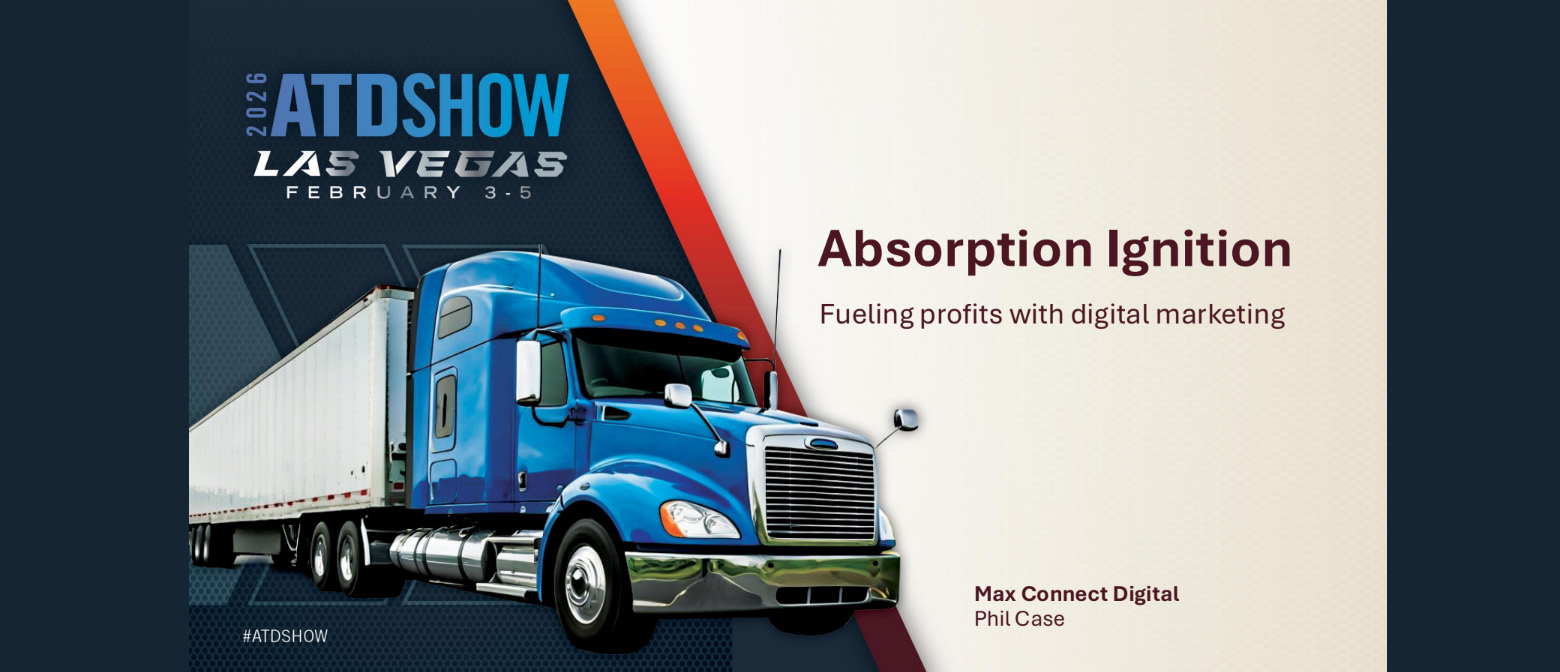
This content was originally presented live at the 2026 ATD Show in Las Vegas
The U.S. trucking industry is one of the foundational engines of the American economy. It moves the majority of domestic freight by weight and generates close to a trillion dollars in annual revenue. And yet today, the dealers who support that engine are operating under extraordinary pressure.
Freight volumes remain below pre-2020 peaks. New truck sales are soft. Fleets are holding onto equipment longer due to affordability concerns, tariffs, and elevated operating costs. Absorption rates — once comfortably in the 100–112% range — are slipping into the 80–90% band for many dealers. That shift changes everything.
Because absorption isn’t just a metric. It’s the thermostat for dealership profitability.
The Late-Cycle Correction Is Structural
The freight market is in what many would describe as a late-cycle correction. Demand is stabilizing, not surging. Operating costs per mile remain high. Trade-policy uncertainty complicates pricing and long-term equipment strategy. Buyers are delaying purchases due to high prices and cost pressures.
For dealers, this creates pressure from both ends:
Higher inventory carrying costs
Softer truck margins
Slower inventory turns
Fleets delaying maintenance
When absorption dips below 100%, dealers are effectively using truck margin to cover overhead. In today’s environment, that’s a fragile position. But within that pressure lies opportunity.
Fixed Ops Is No Longer Support — It’s Strategy
When new truck margins tighten, parts and service don’t just become more important — they become the stabilizing force of the entire dealership.
Fixed operations have inherent structural advantages that sales simply don’t. Service demand is recurring. Every truck you’ve sold becomes part of your installed base. Every repair order strengthens a direct customer relationship. And unlike new truck sales, fixed ops revenue typically carries stronger margins and greater consistency.
The strongest dealers understand that fixed ops isn’t a department — it’s a flywheel.
When parts and service gross profit covers overhead, pressure comes off the sales floor. When overhead is covered, cash flow becomes more flexible. Flexible cash flow allows reinvestment into marketing, visibility, and customer acquisition. More customers lead to more service visits. More service visits lead to stronger retention. And stronger retention produces future truck buyers.
It’s a compounding system.
This isn’t about shifting dollars from one department to another. It’s about building an ecosystem where sales, parts, and service reinforce each other. When one line is cut to plug another, the system weakens. When all three move together, profitability accelerates.
That’s absorption ignition.
The Visibility War Is Happening in Search and Maps
The customer journey hasn’t disappeared — it has condensed.
Today’s fleet manager or owner-operator doesn’t begin with a sales call or a referral. They begin with a search. Google Search. Google Maps. Increasingly, even social platforms. The first impression of your dealership now happens on a screen, often before you ever know a prospect exists.
That shift changes the competitive landscape entirely.
You’re no longer competing only with the dealer down the highway. You’re competing with e-commerce parts retailers offering fast shipping. Independent repair shops with aggressive pricing. Third-party listing platforms aggregating inventory. And every other dealer investing to appear in the same digital spaces within your market.
Visibility has become territory.
Owning local intent is no longer optional — it’s defensive strategy. That means dominating your Google Business Profile presence, building real authority through local SEO, investing in paid visibility within Search and Maps, and deploying demand-capture tools like Performance Max to intercept high-intent parts and service searches. It also means measuring what actually drives revenue — call tracking and RO attribution — because in heavy trucking, the phone still closes the loop.
If your dealership doesn’t show up when customers are searching, you don’t just lose a click. You lose the job. And when you consistently lose visibility, absorption follows.
The 18-Month Retention Danger Window
Service is the number-one retention driver. Most active customers interact with service annually. But once a customer lapses beyond 12–18 months, churn probability rises sharply. Dealers must treat retention as proactively as acquisition:
Win-back campaigns at 6, 12, and 18 months
Lapsed parts reminders
Seasonal and DOT inspection triggers
Strategic use of first-party audiences
Retention isn’t reactive. It’s engineered.
Absorption Ignition in Action
When absorption comes under pressure and competition intensifies, the natural instinct is to tighten up — reduce spend, shift budgets, protect what feels safest. Dollars move from sales to service, from service to parts, depending on which area appears most urgent in the moment.
But that reactive movement often does more harm than good.
Short-term budget shifts create long-term instability. Visibility drops. Momentum stalls. Messaging becomes fragmented. Instead of strengthening absorption, the dealership ends up weakening the very ecosystem that drives it.
The dealers seeing real progress take a different path. Rather than pulling back or redirecting dollars in isolation, they commit to alignment. Sales, parts, and service operate together under a consistent, full-funnel strategy. High-intent demand is captured where it originates. Retention is engineered with structured follow-up and win-back cycles. Inventory is surfaced directly where shoppers are searching, preventing leakage to third-party platforms.
The impact compounds.
Parts revenue grows because visibility remains steady. Phone-driven revenue becomes measurable and reliable. Cash sales strengthen even when credit tightens. Instead of reacting month to month, the dealership builds sustained momentum.
Absorption doesn’t improve because one department outperforms another. It improves when the entire system works in coordination. Consistency across sales, parts, and service is what stabilizes overhead, protects margin, and ultimately turns volatility into opportunity.
That is Absorption Ignition in action.
2026: A Precision Market, Not a Rebound Market
The outlook for 2026 suggests stabilization rather than explosive growth. Freight demand may grow modestly. Carrier profitability should improve from recent lows but remain constrained by equipment and financing costs.
This is not a rebound market. It is a precision market.
Dealers waiting for sales to return to peak-cycle highs will be disappointed. Dealers who treat fixed ops as the ignition system for absorption will be positioned to win.